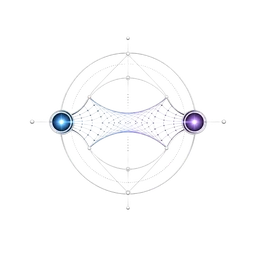
Phase 52 · access-channel paradox · AT-0439 → AT-0453
One substrate, two access states
Seed 439. For the first time in this programme a ratio grows with the size of the world instead of decaying toward 1. Then the audit takes it away: the local unlock front that opens the fast sector is itself a controllable, remotely detectable signal, which makes it a communication channel rather than a shortcut inside a local world. Both halves are published here, unedited.
Plain language
Loading.
Headline numbers
Q at N = 1024
…
Fitted exponent
…
Max substrate degree
…
Channel audit
FAIL
One substrate, two access states
Nothing is added when you flip the switch. Every node and every edge below is present the whole time. In the ordinary state C₀ only the cycle-like couplings are accessible transitions and the pair sits N/2 apart. In the open state C* the latent generic edges become admissible and the shortest lawful path collapses to about log N hops. What changed is not speed. What changed is which transitions are allowed.
Access state
C₀ — ordinary
Shortest lawful path
32 hops
ordinary N/2 = 32 · open ≈ log₂N = 6
Edges in the substrate
64 cycle · 31 latent
unchanged by the switch
No channel detected
Ordinary state. Only cycle-local transitions are admissible.
The access-channel paradox
A latent sector cannot simultaneously be faster through S than ordinary X, locally controllable, and remotely detectable, while still claiming ordinary operational X-locality. Toggle the vertices. Any configuration that lights all three is not a shortcut inside a local world — it is a world whose real causal structure was S all along.
HIDDEN CHANNEL — FAILS ORDINARY X-LOCALITY
All three properties hold at once. A locally chosen action changes something remotely observable in less than ordinary X time, so the unlock front is itself a communication channel. The construction no longer describes a world with ordinary X-locality; it describes a world whose true causal structure is S. Rejected.
What changed? Not speed — allowed transitions
The hypothesis under test replaces “distance is the primitive” with an allowed-transition graph G_allowed(Ψ, C). The substrate may carry rich relations while a constraint layer C decides which transitions are accessible. Gauge-like and code-like structures are named as analogies and classes to test — nothing here is derived from established physics, and none of it is claimed as established.
Five rulers · geometry, diffusion, spectrum, causal time, channel audit
| Ruler | Symbol | Reading at N = 1024 | Scaling | Note |
|---|
Falsification battery A → J
Ten tests written before the result was liked. Failures and unrun tests are shown exactly as they are; nothing unmodeled is reported as a pass.
Verdict gates
Blockers raised