Lab · AT-0021 / AT-0022 / AT-0023
Relational Relocation
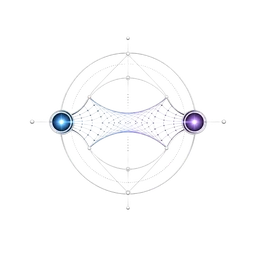
A Traveler with a fixed position and a tracked identity vector. Its relations to the Origin neighbourhood are released and relations to the Destination neighbourhood are formed. Nothing crosses the screen; the links change instead.
AT-0021 inputs
Relational address · Traveler
Similarity is read from the Traveler's relational address R_T = (r_T1 … r_TN) against each neighbourhood. Address distance is −ln of that similarity, in the same units as effective separation.
| quantity | before | after | change |
|---|---|---|---|
| Origin similarity | 0.7960 | 0.1990 | -0.5970 |
| Destination similarity | 0.0498 | 0.6441 | +0.5943 |
| Origin address distance | 0.2281 | 1.6144 | +1.3863 |
| Destination address distance | 2.9991 | 0.4399 | -2.5592 |
Initial D(A,B)
2.5663
Final D(A,B)
0.2231
Adjacency cost C_A
6.5792
Adjacency gain Γ_A
0.3561
Identity deviation ΔI
0.1077
Modified relations
10
Transitions
10
Runtime
—
Visual evidence · AT-0021 relational relocation
10 · Release relation T↔H: 0.812 → 0.203
D at this step
0.2231
C_A at this step
6.5792
ΔI at this step
0.1077
Relations changed
10 / 10
Evidence
non-negativity ok · symmetry ok · triangle inequality ok · identity of indiscernibles ok
Graph connected; shortest-path solution finite and NaN-free.
AT-0 has no time coordinate, no Lorentzian structure and no light cones. Causal behaviour cannot be evaluated until AT-4.
No stress-energy tensor is defined in this model. Energy-condition analysis begins at AT-5.
Whether these graph distances embed into a recognisable manifold is untested until AT-3.
No mapping from relational couplings to measurable physical quantities exists. Graph-distance reduction is not physical distance reduction.
ΔI = 0.1077 against tolerance 0.350 under the stipulated identity-strain model.
Changing a node's relational address in a graph has no established correspondence to relocating a physical object. None is claimed.
- The Traveler's layout coordinates are identical before and after. Only its relational address changed.
AT-0022 · Minimum relocation cost
Cheapest admissible transformation
A deterministic grid over anchor count, anchor strength and release fraction. A row is admissible only if it reaches the destination-similarity target and stays inside the identity tolerance.
AT-0023 · Continuity challenge
Did the modelled transition use intermediate relational states?
Steps
10
Intermediate states
2
Unaffiliated states
0
Used intermediates
yes
The accepted transformation passed through 2 intermediate relational states between the initial and final destination similarity. In this model the transition is not a single discrete jump.
Step count alone cannot decide continuity: under L1 endpoint cost a monotonic multi-step path costs exactly the same as the direct one-step transformation. See the direct-vs-multistep benchmark, adjacency debt and the analytic AT-0022 bound.
| step | transformation | sim_origin | sim_dest | C_A | ΔI |
|---|---|---|---|---|---|
| 0 | Form relation T↔I: 0.000 → 0.800 | 0.7960 | 0.5189 | 0.800 | 0.0480 |
| 1 | Form relation T↔J: 0.000 → 0.800 | 0.7960 | 0.5852 | 1.600 | 0.0619 |
| 2 | Form relation T↔K: 0.000 → 0.800 | 0.7960 | 0.6441 | 2.400 | 0.0657 |
| 3 | Release relation T↔B: 0.792 → 0.198 | 0.7682 | 0.6441 | 2.994 | 0.0950 |
| 4 | Release relation T↔C: 0.790 → 0.198 | 0.7320 | 0.6441 | 3.587 | 0.0968 |
| 5 | Release relation T↔D: 0.780 → 0.195 | 0.7029 | 0.6441 | 4.171 | 0.1232 |
| 6 | Release relation T↔E: 0.808 → 0.202 | 0.6456 | 0.6441 | 4.778 | 0.1234 |
| 7 | Release relation T↔F: 0.767 → 0.192 | 0.6014 | 0.6441 | 5.353 | 0.1489 |
| 8 | Release relation T↔G: 0.824 → 0.206 | 0.5279 | 0.6441 | 5.970 | 0.1305 |
| 9 | Release relation T↔H: 0.812 → 0.203 | 0.1990 | 0.6441 | 6.579 | 0.1077 |