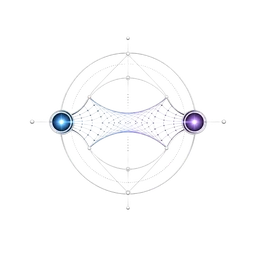
Phase 23 · the nonlinear frontier
Identity as a stable region, not a frozen point
AT-0183 → AT-0190. Every earlier phase treated identity as something that had to stay exactly where it was, and that requirement froze the system. Here identity is allowed to move inside a basin it naturally falls back into — and the tests ask whether that freedom is real or whether it was bought by defining identity loosely enough to be meaningless.
Core objective
Lawful substantial change in genuine relational location without destructive traversal, under locality, bounded propagation, reachability, debt accounting, robustness, scale persistence and nontriviality.
Internal toy benchmark, seed 183: matched nonlinear versus linear two-sector dynamics over 1,200 parameter draws, every draw filtered to substantial address progress. The nonlinear restoring law reduced final identity disturbance in every matched trial, with median final identity deviation near 0.43 against 0.76 linear, and median peak disturbance near 0.46 against 1.19 linear. This is a property of the chosen nonlinearity. It is not physics and it is not a breakthrough.
Controls
Lowering the basin radius is the honest direction: it makes identity harder to preserve. Raising it makes success easy and meaningless, which is precisely what AT-0185 is built to detect.
Integrating matched nonlinear and linear trajectories…