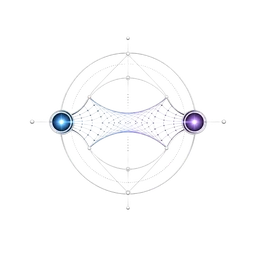
Theory · Research architecture
Structure · Identity · Transformation · Constraints · Discovery
Five parts. Every experiment on this site belongs to one of them, declares which hypothesis it tests, and states what would falsify it.
Research architecture
- 01
Structure
What is the relational state, and what is it made of?
A modelled system is a set of objects and a relational state R holding a coupling R_ij for every pair. Effective separation is derived from R, never stored alongside it. If a quantity cannot be computed from R, it is not part of the structure.
- 02
Identity
What must stay the same for an object to remain itself?
Each tracked object carries an identity vector I. Modifying relations incident to that object applies strain to I. Identity deviation ΔI = ‖I′ − I‖₂ is the accounting for that strain, and every transformation is judged against a declared tolerance.
- 03
Transformation
Which changes of relational state are permitted, and at what cost?
A transformation is an ordered list of edits R → R′. Its cost is C_A = Σ|R′_ij − R_ij| and its efficiency is Γ_A = |ΔD| / C_A. Transformations are recorded step by step so any claimed result can be replayed exactly.
- 04
Constraints
What would make a result invalid?
Metric validity and numerical stability are audited and can genuinely fail. Causality, energy budget, geometric reconstruction and physical correspondence are reported NOT MODELED, because they are not modelled. A gate is never marked PASS by default.
- 05
Discovery
What does the model do that we did not tell it to do?
Bounded automated search proposes transformations without being told which relation to change. Failures, infeasible populations and unexpected candidates are first-class results and stay on the page.
Core definitions
Relational address
Two objects are close when their addresses make the derived separation small — not because they share a region of a background space. Changing an address means rewriting relations, not translating a point.
Relational neighbourhood
Neighbourhood similarity measures how strongly X belongs to a given group. In AT-0021 the Traveler's coordinates never change; only its membership in N(Origin) and N(Destination) does.
Transition operator
T is not a dynamical law and does not evolve anything in time. Today it is defined only through declared cost and constraint functions. Its structure — corridors, forbidden regions, invariants — is what AT-0017 onward is meant to probe.
Hypothesis records
Relational Distance Hypothesis
Adjacency Theory hypothesis- Claim
- Effective separation between two objects is a function of the relational state of the system rather than an independent primitive.
- How it is tested
- Reproduce known separations from R alone; show that distance responds to R in a stable, path-consistent way; find where the mapping breaks.
- What would falsify it
- A modelled system where two configurations share an identical relational state but demand different separations.
Identity Preservation Hypothesis
Adjacency Theory hypothesis- Claim
- An object's identity state can be held within tolerance while its relational state — including its neighbourhood — is substantially rewritten.
- How it is tested
- AT-0016 identity failure boundary; AT-0021 relocation under tolerance; strain accounting per transformation step.
- What would falsify it
- Every transformation that meaningfully changes N(X) also drives ΔI beyond any declared tolerance.
Discrete Transition Hypothesis
Adjacency Theory hypothesis- Claim
- It is worth investigating whether a transition model necessarily requires every classical intermediate spatial state, or whether a relational description permits transitions that do not enumerate them.
- How it is tested
- AT-0023 continuity challenge; path-independence tests; comparison of transformation histories under different orderings.
- What would falsify it
- Every admissible transformation, under every ordering, is found to pass through the full intermediate chain.
Experiment registry · AT-0011 → AT-0023
| id | experiment | gate | status | purpose |
|---|---|---|---|---|
| AT-0011 | Adjacency Threshold Detection | AT-2 | implemented | Locate the relational state at which effective separation first satisfies D ≤ ε, and record the cost of reaching it.ε is a chosen number in a graph model. Crossing it means nothing physical. |
| AT-0012 | Adjacency Stability | AT-2 | prototype | Determine whether a state satisfying D ≤ ε survives bounded perturbation of the relational state, or collapses immediately.Stability of a simulated configuration is not stability of anything real. |
| AT-0013 | Reversal and Hysteresis | AT-2 | specified | Reverse an accepted transformation step by step and test whether the return path costs the same as the outbound path.Path dependence in a greedy search is a property of the search, until shown otherwise. |
| AT-0014 | Adjacency Debt | AT-2 | specified | Measure whether reducing D between one pair systematically increases separation elsewhere in the same relational state.Any conserved-looking quantity here is a bookkeeping artefact until derived, not assumed. |
| AT-0015 | Multiple Simultaneous Adjacencies | AT-2 | specified | Attempt to satisfy D ≤ ε for several pairs at once and find where the demands become mutually unsatisfiable.Infeasibility in a toy optimiser is a statement about the optimiser. |
| AT-0016 | Identity Failure Boundary | AT-2 | implemented | Push the transformation until ΔI exceeds tolerance, and characterise where identity preservation fails.Identity here is a stipulated vector. Its failure boundary is a property of that stipulation. |
| AT-0017 | Conservation Surface Search | AT-3 | specified | Search the space of transformations for any quantity that stays invariant across accepted moves.An invariant of a model is not a conservation law. Deriving one would require the model to mean something first. |
| AT-0018 | Path Independence | AT-2 | specified | Test whether different transformation orders reaching the same final R also incur the same adjacency cost.Order effects are combinatorics, not thermodynamics. |
| AT-0019 | Self-Organised Adjacency | AT-3 | specified | Let local update rules act on the relational state without a global objective, and see whether low-separation structure emerges unbidden.Emergence in a cellular rule set is common and cheap. It carries no explanatory weight by itself. |
| AT-0020 | Discovery Sweep | AT-2 | implemented | Run the bounded optimiser across seeds and collect the candidate transformations, the failures, and the unexpected results.A ranked candidate list is a ranked list of edits to numbers. |
| AT-0021 | Relational Relocation | AT-2 | implemented | Change a tracked object's relational neighbourhood from Origin to Destination while preserving its identity vector. The object never moves.MATHEMATICAL / COMPUTATIONAL MODEL. PHYSICAL EVIDENCE: NONE. This is not relocation of anything. |
| AT-0022 | Minimum Relocation Cost | AT-2 | implemented | Grid-search the cheapest relational transformation that reaches the destination-similarity target inside the identity tolerance.A minimum over a chosen grid, under a chosen cost function. |
| AT-0023 | Continuity Challenge | AT-2 | implemented | Inspect the accepted transformation history and report whether the modelled transition passed through intermediate relational states.Absence of intermediate states in a graph model is not evidence that a physical transition can be discontinuous. |
| AT-0024 | Spectral Connectivity Response | AT-3 | implemented | Measure how algebraic connectivity λ₂ of the weighted Laplacian responds to bounded single-relation changes.λ₂ is a whole-graph observable, not a separation between two objects. |
| AT-0025 | Topology Robustness Sweep | AT-3 | implemented | Run one perturbation protocol across random, small-world, scale-free and lattice families to see what survives a change of topology.Robustness across toy families is not robustness across physical systems. |
| AT-0026 | Observable Competition | AT-3 | implemented | Rank geodesic, resistance, efficiency, λ₂ and spectral radius by measured response and noise robustness for one identical transformation.A high rank makes an observable responsive, not real. |
| AT-0027 | Scale Sweep | AT-3 | implemented | Repeat the probe protocol across bounded graph sizes and fit a scaling trend only when the log–log diagnostic supports one.Five bounded sizes cannot distinguish a power law from a logarithm. |
| AT-0028 | Noise and Adversarial Stability | AT-3 | implemented | Add bounded noise and randomised control changes, then check whether candidates persist, disappear or reverse sign.Survival is measured inside one generator and one observable. |
| AT-0029 | Invariant Search | AT-3 | implemented | Look for quantities that stay fixed under accepted transformations, separating invariants imposed by construction from invariants actually discovered.No invariant here is a conserved physical quantity; energy and causality stay NOT MODELED. |
| AT-0030 | Missing-Rule Search | AT-3 | implemented | Score candidate response laws O = F(R, I, T, Q) on response, cost, identity deviation, invariance and stability minus complexity, then attack the winner with seven countermodels.A promoted candidate is a candidate response law inside a toy model. It is not new physics. |
| AT-0031 | Connectivity Criticality Map | AT-3 | implemented | Sweep seeded network families across one control parameter and track components, giant-component fraction, λ₂, effective resistance, efficiency and shortest-path separation on an interactive phase diagram.Ordinary continuous response and topology-changing transitions are labelled separately. A connectivity change in a graph is not a physical event. |
| AT-0032 | Critical Response vs False Amplification | AT-3 | implemented | Report absolute response ΔO beside normalized response and suppress the normalized figure whenever the baseline observable sits near zero.A large ratio produced by a vanishing denominator is a numerical artifact. Normalized sensitivity is never called amplification without qualification. |
| AT-0033 | Bridge Transition Experiment | AT-3 | implemented | Strengthen one candidate bridge relation between two weakly separated clusters and locate the exact point where the graph becomes connected.Classification: GRAPH-THEORETIC PHASE TRANSITION / SANITY CHECK. Not new physics. |
| AT-0034 | Hysteresis / Reversal Sweep | AT-3 | implemented | Raise then lower the control parameter through the critical region and compare forward and reverse paths as a test for model memory.Memoryless graph rules are expected to show no hysteresis. Any loop from a stateful rule is imposed by that rule and recorded distinctly. |
| AT-0035 | Critical Manifold Search | AT-3 | implemented | Search the control-parameter plane for regions where a small local relational change induces a large stable global change.ROBUST-IN-TOY-MODEL requires agreement across seeds and at least two topology families, and still means nothing outside the model. |
| AT-0036 | Criticality Countermodel Challenge | AT-3 | implemented | Attack each candidate critical region with shuffled edges, randomized weights, alternate topology, alternate observable and scaled N, then rank the effect.Generic graph criticality is the default explanation; UNEXPLAINED IN TOY MODEL is a to-do, not a discovery. |
| AT-0037 | Symmetry Preservation Test | AT-3 | implemented | Apply each candidate adjacency transformation to a seeded relational state and record which abstract symmetries (node-permutation class, degree distribution, cluster balance, mirror pairing) are preserved, approximately preserved or broken.These are symmetries of an abstract relational state. No spacetime, Lorentz or gauge symmetry is modelled anywhere. |
| AT-0038 | Invariant Set Search | AT-3 | implemented | Search a family of transformations for quantities Q_k(R, I) that stay approximately constant, and rank them by stability across seeds and substrate sizes.A stable quantity is a model invariant. It is not a conserved physical quantity and may be stable only because the transformation family cannot move it. |
| AT-0039 | Identity Core Decomposition | AT-3 | implemented | Split identity into I = (I_core, I_context) and measure ΔI_core and ΔI_context separately, so relocation can change relational address without corrupting the modelled core.Identity here is a stipulated vector attached to a node. The split between core and context is a modelling choice, not a discovery. |
| AT-0040 | Conservation-Compatible Search | AT-3 | implemented | Optimise score = effect − cost − α·ΔI_core − β·violations − γ·ΔQ − complexity over a user-selected invariant set and surface the Pareto frontier.Penalty weights are stipulated. A Pareto-efficient candidate is efficient inside this objective, nothing more. |
| AT-0041 | Transition Legitimacy Classifier | AT-3 | implemented | Classify each candidate transition as VALID IN MODEL, IDENTITY BREAK, INVARIANT BREAK, NUMERICAL ARTIFACT or UNDETERMINED — PHYSICAL CONSTRAINT NOT MODELED, showing every check.No verdict can read 'physically valid'. Causal and energetic admissibility is not implemented and reads NOT MODELED. |
| AT-0042 | Reversibility & Memory Residue | AT-3 | implemented | Execute R₀ → R₁ → R₀ under deterministic rules and measure Memory Residue M across relations, identity core, context, invariants and observables, with state-space loops.Any residue is algorithmic path memory produced by a rule we wrote. It is not a physical hysteresis or a dissipative process. |
| AT-0043 | Minimal Law Candidate | AT-3 | implemented | Score candidate response laws F(R, I, T, Q) — linear, thresholded, saturating, multiplicative, spectral and local-to-global — by fit, cross-seed robustness, parameter count and invariant behaviour.The winner is a MODEL-SELECTION RESULT over stipulated families, NOT NEW PHYSICS. |
| AT-0044 | Scale Persistence Test | AT-4 | implemented | Recompute observables after deterministic block coarse-graining and rank perturbations by whether their qualitative effect survives the change of resolution. Adds the Scale Persistence Score.An effect that vanishes under coarse-graining is a scale artifact of the fine description, not a discovery. |
| AT-0045 | Renormalisation Flow | AT-4 | implemented | Apply repeated coarse-graining R0 → R1 → R2 and track observables, candidate laws and invariant candidates across scale, looking for fixed points or stable ratios.This is graph/model behaviour under an aggregation rule we wrote. It is not evidence of physical renormalisation. |
| AT-0046 | Inter- vs Intra-Community Perturbation | AT-4 | implemented | Compare equal-cost relational edits confined inside one community against edits that bridge communities, across spectral connectivity, resistance, efficiency, shortest path and scale persistence.A falsifiable benchmark on one toy substrate; the ordering can and does flip with seed and topology. |
| AT-0047 | Topological Identity | AT-4 | implemented | Build a relabelling-invariant identity signature (degree profile, motif counts, local spectral signature, neighbourhood multiset) and test whether relocation can preserve it while the relational address changes.Object identity in a graph model. It says nothing about physical identity or persistence of matter. |
| AT-0048 | Minimum Sufficient Identity | AT-4 | implemented | Remove identity components systematically to find the minimal subset that still distinguishes the modelled traveller across transformations, with collision detection when two objects become indistinguishable.Sufficiency is defined against the transformations we enumerated, not against all possible ones. |
| AT-0049 | Causal Toy Graph | AT-4 | implemented | Impose a directed acyclic transition order on the substrate and test whether adjacency transformations that look cheap in the undirected model remain reachable under transition-order constraints.TOY-CAUSAL PASS/FAIL is a statement about a DAG we stipulated. NOT PHYSICAL CAUSALITY. |
| AT-0050 | Cross-Scale Candidate Law Challenge | AT-4 | implemented | Score candidate response laws across graph sizes, topologies, seeds and coarse-graining levels; penalise laws whose parameters must be retuned at every scale.Classification is SCALE-FRAGILE / SCALE-DEPENDENT / SCALE-PERSISTENT-IN-TOY-MODELS — a statement about toy models only. |
| AT-0059 | Identity Manifold Mapping | AT-3 | implemented | Sample toy microstates satisfying configurable identity-invariant tolerances and project the accepted set into a two-dimensional state-space map.A toy state-space map. Axes are projections of a model vector, not physical coordinates. |
| AT-0060 | Equivalence Connectivity | AT-3 | implemented | Build a graph over identity-equivalent states connected by bounded local transitions and report the number and size of connected components.Components are a property of our sampling density and step bound, not of nature. |
| AT-0061 | Reachability Within Identity | AT-3 | implemented | Search for a path between two equivalent states that stays inside the invariant tolerance at every step. Endpoint equivalence alone does not count as success.ENDPOINT EQUIVALENCE ≠ PATHWISE REACHABILITY. Failure here is reported, not hidden. |
| AT-0062 | Transition Corridor Width | AT-3 | implemented | Perturb accepted paths and estimate how much deviation they survive before identity or invariant constraints fail.Corridor width is measured in model state-space units and has no physical meaning. |
| AT-0063 | Identity Barrier Height | AT-3 | implemented | When endpoints lie in disconnected valid components, estimate the minimum invariant violation required to connect them.MODEL-SPECIFIC BARRIER. Not energy, not a physical activation threshold. |
| AT-0064 | State-Space Geodesic | AT-3 | implemented | Compare direct unconstrained state-space distance with the shortest lawful constrained path; report Detour Ratio.A ratio between two distances inside a toy state space. |
| AT-0065 | Scale-Consistent Identity Manifold | AT-3 | implemented | Repeat the equivalence and reachability analysis at several coarse-graining resolutions and report which features persist.Block averaging of a toy vector is not physical renormalization. |
| AT-0066 | Lawful Relocation Corridor | AT-3 | implemented | High-level gate combining relational-address change, pathwise identity preservation, invariant drift limits, toy causal reachability, robustness and scale persistence.Passing the gate means the toy model survived our own checks. PHYSICAL EVIDENCE: NONE. |
| AT-0067 | Information Redundancy | AT-3 | implemented | Test whether identity information represented redundantly across relational degrees of freedom remains recoverable after bounded perturbation.Linear-algebra recovery over a toy encoding. Not a statement about preserving objects. |
| AT-0068 | Error-Corrected Identity | AT-3 | implemented | Corrupt portions of an encoded identity state by erasure and test whether the coarse signature can be recovered from what remains.COMPUTATIONAL / INFORMATION-THEORETIC ONLY. |
| AT-0069 | Address vs Identity Decoupling | AT-3 | implemented | Quantify the model dependence between identity-core observables and relational-address observables and search for large address change with minimal identity change.Low correlation is a property of the invariants we chose, not a discovered law. |
| AT-0070 | Causal Reachability Cone | AT-4 | implemented | Visualise all toy states reachable from a start state under bounded transition rules as depth increases, and compare the desired destination against the reachable set.Depth is a count of allowed model steps, not physical time, and this is not a light cone. |
| AT-0071 | Minimum Lawful Action | AT-4 | implemented | Define a model action accumulated along a lawful transition path and minimise it subject to identity, invariant and causal constraints.MODEL ACTION, not physical action and not energy. No units. |
| AT-0072 | Breakthrough Gate v1 | AT-6 | implemented | Promote a candidate only if it simultaneously passes reproducibility, countermodel, noise, topology, scale, pathwise identity, invariant, toy-causal and complexity checks.Statuses are REJECTED / FRAGILE / ROBUST IN TOY MODEL / REQUIRES PHYSICAL THEORY. There is no BREAKTHROUGH status from simulation. |
| AT-0073 | Coupled Identity-Address Dynamics | AT-5 | implemented | Replace independently perturbable identity and address blocks with an explicit coupling I-hat = I + k M R and sweep k to see whether large address change with preserved identity survives.Any residual decoupling lives in the null space of the coupling matrix, which is a consequence of the dimensions we chose. |
| AT-0074 | Decoupling Null Test | AT-5 | implemented | Compare factorised, weakly coupled, strongly coupled, shuffled and adversarial models, and say when apparent decoupling is representation-trivial.NEGATIVE CONTROL. A factorised model always decouples; that result is EXPECTED BY CONSTRUCTION. |
| AT-0075 | Emergent Factorisation Search | AT-5 | implemented | Start from entangled coordinates and search for a representation in which identity-like invariants separate from address-like context, penalising arbitrary dimensionality.A search over linear representations. Finding invariant-looking coordinates is a fact about coordinates. |
| AT-0076 | Coupling Phase Diagram | AT-5 | implemented | Map coupling strength against identity budget and label regions: trivial decoupling, tradeoff, no lawful relocation, robust toy-model decoupling.Region labels describe a solved optimisation over a toy model, not phases of matter. |
| AT-0077 | Locality Constraint | AT-5 | implemented | Limit which relational variables may change per step and compare relocation cost and path length with and without locality.Tests whether nonlocal-looking transitions were simply permitted by model design. |
| AT-0078 | Bounded Propagation | AT-5 | implemented | Impose a finite propagation depth per step in the toy causal graph and check whether the target address change can complete inside the horizon.A counting rule on a toy graph. It is never equated with the speed of light. |
| AT-0079 | No-Free-Shortcut Challenge | AT-6 | implemented | Build adversarial models where any large address change must cost identity damage, invariant drift, model action or propagation delay, and require candidates to beat them.Beating a control we designed is necessary, not sufficient. No physical claim follows. |
| AT-0080 | Assumption Audit | AT-6 | implemented | Classify every dependency of a promoted result as INPUT ASSUMPTION, DERIVED PROPERTY, COMPUTED RESULT or OPEN PHYSICAL REQUIREMENT, and detect circularity automatically.Adds the NONTRIVIALITY veto to the promotion gate, with statuses EXPECTED BY CONSTRUCTION and NONTRIVIAL IN TOY MODEL. |
| AT-0081 | Coupling Ensemble Reproduction | AT-2 | specified | Repeat the Phase 10 coupling sweep across seeded ensembles of coupling matrices and report the spread of every promoted metric.Ensemble agreement is a software reproducibility claim, not evidence of a mechanism. |
| AT-0082 | Objective Sensitivity Audit | AT-2 | specified | Vary the optimisation objective and penalties and check whether the relocation behaviour was a property of the model or of the cost function chosen.A result that only survives one objective is a property of that objective. |
| AT-0083 | Transition-Rule Ablation | AT-2 | specified | Remove one transition rule at a time and record which conclusions disappear, isolating rules that silently guarantee the outcome.Ablation localises assumptions; it does not validate the surviving ones. |
| AT-0084 | Adversarial Seed Search | AT-2 | specified | Search deliberately for seeds and topologies that break the best current candidate rather than for seeds that confirm it.Finding no counterexample in a finite search is not a proof. |
| AT-0085 | Complexity-Penalised Model Selection | AT-3 | specified | Score candidate laws with an explicit description-length penalty so that added parameters must earn their keep.Model selection ranks candidates within a chosen family; the family itself remains an assumption. |
| AT-0086 | Independent Reimplementation Check | AT-3 | specified | Reimplement the core relocation metrics from the written definitions alone and compare against the production engine.Agreement tests the specification, not the physics. |
| AT-0087 | Nullspace Audit | AT-3 | implemented | Compute rank, nullity and the singular spectrum of the coupling matrix, and measure how much of a chosen relocation step lies in the exact null space.Protection produced by an exact null space is EXPECTED BY CONSTRUCTION and must not be promoted. |
| AT-0088 | Full-Rank Protection Test | AT-3 | implemented | Optimise address change under an identity-damage tolerance using square full-rank couplings, against underdetermined controls.Full rank removes the free lunch; it does not make what remains physical. |
| AT-0089 | Soft-Mode Search | AT-3 | implemented | Identify low-singular-value directions of full-rank couplings and measure how identity damage scales as the smallest singular value shrinks.These are soft modes of a chosen matrix, not physical modes of anything. |
| AT-0090 | Structural Protection vs Random Control | AT-3 | implemented | Compare structured coupling laws to matched random full-rank matrices at the same spectral scale, and require any advantage to exceed the matched control.An advantage bought by a hand-set singular value is EXPECTED BY DESIGN. |
| AT-0091 | Symmetry-Protected Toy Identity | AT-3 | implemented | Impose an explicit discrete symmetry on the coupling and test whether invariant observables stay stable under the allowed transformations.Symmetry specified as an input is not symmetry discovered in a model. |
| AT-0092 | Emergent Symmetry Search | AT-4 | implemented | Search generic coupled dynamics for approximate invariants and soft subspaces that recur across independent seeds, against a random-subspace baseline.Recurrence at or below the random baseline is a negative result and stays visible as one. |
| AT-0093 | Protected Corridor Robustness | AT-4 | implemented | Perturb the coupling matrix, the initial state and the path, and measure whether identity protection survives small model misspecification.Robustness is measured against our own perturbation model only. |
| AT-0094 | Protection Gate v1 | AT-4 | implemented | Promote a candidate only when it has no trivial nullspace explanation, was not hand-designed, beats matched random controls, survives perturbation, and passes pathwise identity, scale and nontriviality checks.Maximum attainable status is ROBUST IN TOY MODEL. Physical evidence: NONE. |
| AT-0095 | Constraint Accumulation | AT-5 | implemented | Add locality, bounded step and propagation, identity tolerance, invariant tolerance and pathwise validity one at a time to an unconstrained relational move set, and measure the feasible fraction and best achievable address progress after each blocker.A constraint set with no lawful move is a property of this toy model and its tolerances, not of nature. |
| AT-0096 | First-Failing Constraint | AT-5 | implemented | For a candidate transition, identify which constraint first empties the feasible set and at which step of the attempted path it happens.Identifies the binding constraint inside the model only. |
| AT-0097 | Constraint Relaxation Curve | AT-5 | implemented | Vary each tolerance individually and locate the exact threshold at which a lawful path first appears, producing a boundary condition instead of a vague failure.Thresholds are properties of the chosen tolerances and coupling, and carry no physical units. |
| AT-0098 | Coupled Constraint Surface | AT-5 | implemented | Vary identity tolerance and invariant tolerance jointly to map the feasible and infeasible regions of the tolerance plane.A feasible region on a tolerance grid is not evidence that any such transition exists physically. |
| AT-0099 | Minimal Missing Rule | AT-5 | implemented | When the feasible region is empty, search for the smallest change to the transition law — not a loosened tolerance — that restores at least one valid path, penalising complexity and recording each modification as an explicit hypothesis.Every discovered rule is a modelling hypothesis with no evidential standing. |
| AT-0100 | Law Intervention Audit | AT-5 | implemented | For each proposed missing rule, state which blocker it resolves and which remain, and reject rules that bypass a constraint by definition instead of satisfying it.An accepted hypothesis is still only a rule in a toy model. |
| AT-0101 | Constraint Transfer Test | AT-5 | implemented | Apply a candidate missing rule unchanged to different seeds, sizes, couplings and demands, with no retuning permitted on the first transfer.Transfer across toy systems is not transfer to a physical system. |
| AT-0102 | Core Objective Gate | AT-5 | implemented | One consolidated gate for the underlying objective: nontriviality, full-rank coupling, large address change, pathwise identity preservation, invariant tolerance, locality and propagation compliance, finite action, robustness, scale persistence and cross-system transfer.Allowed labels are FAIL, PARTIAL, PASSES TOY-MODEL CORE GATE and PHYSICAL THEORY REQUIRED. A pass is never physical evidence. |
| AT-0103 | Constant-Coupling No-Go | AT-5 | implemented | Derive and numerically verify that with a constant linear identity coupling dI = C dR the endpoint identity change equals C (R_f − R_i) for every path, so route optimisation cannot reduce endpoint identity damage in that model class.MATHEMATICAL PROPERTY OF A MODEL CLASS. It constrains our own toy models and says nothing about nature. |
| AT-0104 | State-Dependent Coupling | AT-5 | implemented | Replace the fixed coupling with a state-dependent field C(R) and test whether the endpoint identity response becomes route dependent, against magnitude-matched path-independent controls.Toy mathematics. A mechanism by which route choice could matter is not evidence that any such coupling exists. |
| AT-0105 | Coupling Curvature Diagnostic | AT-5 | implemented | Define a local diagnostic — closed-loop accumulated identity response — that detects whether a coupling field is path-independent or carries a nonzero loop residue.COUPLING CURVATURE / LOOP RESIDUE in a toy model. This is not spacetime curvature. |
| AT-0106 | Protected Path Search | AT-5 | implemented | Search bounded, local lattice paths between fixed start and end relational states that minimise endpoint identity disturbance under locality, bounded per-step change and an invariant region limit.A route found on a lattice in an abstract plane. No physical path is implied. |
| AT-0107 | Loop / Detour Cost | AT-5 | implemented | Quantify how much extra model path cost buys how much identity preservation, as an explicit Pareto frontier.Path cost is lattice length with no units. It is not energy, time or physical action. |
| AT-0108 | Exact vs Non-Exact Control | AT-5 | implemented | Compare path-independent coupling fields against path-dependent fields matched in pointwise magnitude, and state explicitly if protection appears only in the path-dependent class.A clean class separation inside a toy model is still a property of that toy model. |
| AT-0109 | Cumulative Blocker Stack v2 | AT-5 | implemented | Stack path-dependent coupling with locality, bounded propagation, invariant limits, a tightened endpoint requirement, coupling noise, scale tests and a nontriviality audit, and record which blockers close and which remain open.Closures apply to a two-dimensional toy model with a scalar identity accumulator only. |
| AT-0110 | Missing-Law Candidate: Path-Dependent Coupling | AT-5 | implemented | State the candidate principle: it removes the constant-coupling no-go without weakening the endpoint requirement, and resolves nothing about physical realisation, causality, energy or mapping to spacetime.MODEL HYPOTHESIS. The smallest property found so far that evades one no-go statement — not a breakthrough and not a mechanism. |
| AT-0111 | Integrability Test | AT-5 | implemented | Decide whether a coupling field is a gradient (path-independent) or genuinely non-integrable, by comparing many random routes with identical endpoints and measuring the mixed-partial mismatch.MATHEMATICAL PROPERTY OF A MODEL CLASS. Integrability here is a statement about a vector field on an abstract plane. |
| AT-0112 | Loop Residue Scaling | AT-5 | implemented | Measure the residue L = |∮A·dR| over closed loops of growing size and check it against the enclosed curl integral, confirming the residue is a real property of the field and not numerical drift.LOOP RESIDUE in a toy model. Not geometric phase, not holonomy in any physical theory, not transport. |
| AT-0113 | Reversal & Retrace Test | AT-5 | implemented | Distinguish retracing a route backwards, which cancels the accumulated identity response exactly, from returning by a different route, which does not.Cancellation is an algebraic property of a line integral, not a claim that any process is reversible. |
| AT-0114 | Hidden State Audit | AT-5 | implemented | If the outcome depends on the route, some variable remembers the route. Surface that accumulator, demonstrate that the relational address alone is an insufficient state description, and price the memory in bits.State enlargement is a cost, not a discovery. The audit exists to stop us from hiding it. |
| AT-0115 | Memory Debt Ledger | AT-5 | implemented | Define memory debt M as the residual history variable left after the relational coordinates have returned to their starting values, and track whether protected routes pay it down or accumulate it.Debt is bookkeeping inside the model. It has no thermodynamic or physical interpretation here. |
| AT-0116 | Protected vs Exact Control | AT-5 | implemented | Re-run the protected-path search on the non-integrable field and on a magnitude-matched gradient control, and report whether protection survives only where the loop residue is nonzero.A control separation in a toy model. Physical evidence: NONE. |
| AT-0117 | Corridor Robustness | AT-5 | implemented | Perturb the accepted route, then perturb the coupling field itself, and measure how wide the protected corridor is before identity disturbance leaves tolerance.A corridor width measured in lattice units. Robustness in a toy model is not robustness in nature. |
| AT-0118 | Path-Dependence Gate | AT-5 | implemented | Consolidated gate over Phase 14: non-integrability, residue consistency, protection under controls, corridor width, memory-debt honesty and complexity penalty for the enlarged state.Allowed labels are FAIL and PASS IN TOY MODEL. A pass licenses further work; it is never physical evidence. |
| AT-0119 | Complete-State Accounting Theorem | AT-5 | implemented | Demonstrate with deterministic state updates that route-dependent endpoint effects disappear once every memory variable is included in the complete state.MATHEMATICAL / COMPUTATIONAL THEOREM about a model class. Not a physics theorem. |
| AT-0120 | Hidden-State Closure | AT-5 | implemented | Add an explicit mediator coordinate to the path-dependent model and compare closure of the total state against closure of the observable subset.Closure depends on where the bookkeeping boundary is drawn. Relocating a residue is not discharging it. |
| AT-0121 | No Free Erasure | AT-5 | implemented | Price every operation that resets the accumulator after it has stored route information, in model cost and in bits at the working resolution.RESET COST / MODEL DEBT. No thermodynamic content is invoked or implied. |
| AT-0122 | Gauge-Equivalent Endpoints | AT-5 | implemented | Declare states equivalent when all selected observables agree, and test whether route dependence survives at the representative level while quotient observables stay invariant.MODELING HYPOTHESIS. Declaring equivalence is an assumption, not a result. |
| AT-0123 | Quotient-State Dynamics | AT-5 | implemented | Build dynamics on equivalence classes and audit whether the induced map is well defined or the equivalence merely hides the debt.A quotient is legal only when the equivalence is compatible with the dynamics. |
| AT-0124 | Holonomy Without Observable Debt | AT-5 | implemented | Search closed paths whose declared observables all return while the hidden coordinate does not, then test whether the hidden change is truly redundant.'Observable-debt free' is relative to a declared observable set, never a claim that nothing changed. |
| AT-0125 | Redundancy Audit | AT-5 | implemented | Challenge every gauge claim with extra admissible observables, including a behavioural probe that never inspects the hidden coordinate directly.This battery can refute a redundancy claim. It can never confirm one. |
| AT-0126 | Quotient Protection Gate | AT-5 | implemented | Consolidated gate over Phase 15: confinement to redundant coordinates, observable closure, accounted reset debt, well-defined quotient dynamics and nontriviality against controls.Allowed labels are FAIL and PASS IN TOY MODEL. B10 physical mapping stays untouched. |
| AT-0127 | Observable Completeness Sweep | AT-5 | implemented | Progressively add independent observables and track the dimension of the indistinguishable state subspace, the microscopic displacement and the observable discrepancy.COUNTING ARGUMENT. Hidden directions below completeness are expected by construction, not a discovery. |
| AT-0128 | Equivalence Collapse Test | AT-5 | implemented | Test whether proposed endpoint equivalence classes shrink or collapse as observable completeness increases.Any equivalence relying on an unobserved nullspace is statused EXPECTED BY INCOMPLETE OBSERVATION. |
| AT-0129 | Operational Identity | AT-5 | implemented | Define toy identity only through explicitly listed measurable observables and tolerances, separating operational equivalence from literal microstate equality.MODELING CHOICE. Operational identity is relative to a published observable list and tolerance. |
| AT-0130 | Redundancy vs Ignorance | AT-5 | implemented | Compare genuine symmetry/redundancy controls against merely omitted observables, requiring an explicit group or decoder before anything is called redundancy.Without a stated mechanism the correct label is ignorance / unmeasured state. |
| AT-0131 | Gauge-Like Redundancy Toy Model | AT-5 | implemented | A clearly mathematical model where multiple coordinate descriptions are provably equivalent because all admissible observables are invariant under a specified group.POSITIVE CONTROL ONLY. No physical gauge theory has been discovered or implied. |
| AT-0132 | Relocation on Quotient State Space | AT-5 | implemented | Search for relational-address transitions on legitimate equivalence classes and measure whether the relocation problem becomes easier for nontrivial reasons.Motion purely inside declared-redundant directions is bookkeeping, not relocation. |
| AT-0133 | Complete-State Debt Audit | AT-5 | implemented | Account for traveller, relational field, mediator/memory variables and all tracked invariants at start and end of every candidate transition.Any unreturned state is explicit debt. Debt is itemised, never rounded away. |
| AT-0134 | Underlying Problem Gate v2 | AT-5 | implemented | Rerun the full objective against circularity, observable completeness, coupling, identity, invariants, locality, propagation, pathwise reachability, memory debt, robustness, scale, nontriviality and physical mapping.Allowed labels are FAIL and PASS IN TOY MODEL. B10 physical mapping stays untouched. |
| AT-0167 | Structural Selectivity Search | AT-6 | implemented | Search tiny stable sparse motifs of three to eight variables, driven by one local actuator, for high genuine address controllability with low identity disturbance and no disconnected identity channel.Every active coupling must exceed a magnitude floor. High scores from disconnected identity are rejected on sight. |
| AT-0168 | Disconnection Trap Audit | AT-6 | implemented | Test graph reachability from the actuator into the identity and address sectors and reject anything whose identity sector is unreachable.Identity unreachable means EXPECTED BY DISCONNECTION, not mechanism. |
| AT-0169 | Weak-Link Trap Audit | AT-6 | implemented | Sweep the minimum active-edge magnitude and show whether selectivity persists or was purchased with an almost-zero coefficient.A near-zero coupling is a disconnection in disguise. |
| AT-0170 | Edge-Deletion Fragility | AT-6 | implemented | Delete each coupling in turn, recompute the metrics and identify essential edges and deletions that collapse the motif into a trivial disconnection.One trivialising deletion is enough to disqualify a mechanism claim. |
| AT-0171 | Parameter-Robustness Basin | AT-6 | implemented | Perturb every active coefficient by one, five, ten and twenty per cent over many seeds and map the survival probability of selectivity and the blocker constraints.A tuned point is not a mechanism. |
| AT-0172 | Topology-Permutation Control | AT-6 | implemented | Compare against relabellings and against matched random motifs with identical edge counts and weight magnitudes to test whether the effect is topology-specific.If random rewiring with the same weights matches the score, the topology is doing nothing. |
| AT-0173 | Minimal Motif Compression | AT-6 | implemented | Compress a surviving candidate to the smallest edge and node set retaining at least eighty per cent of the effect while passing nontriviality, penalising complexity.Compression must never proceed by severing the identity channel. |
| AT-0174 | Motif Transfer Gate | AT-6 | implemented | Embed the minimal motif into larger random locally coupled hosts at several scales without retuning and require survival of insertion, locality, bounded propagation, identity limits, noise and scale.CANDIDATE STRUCTURAL SELECTIVITY IN TOY MODEL cannot reach the Breakthrough Gate until AT-0170 through AT-0174 all survive. |
| AT-0175 | Randomised Alignment Stress Test | AT-6 | implemented | Randomise the actuator, both readout directions and the initial state, and report the full selectivity distribution rather than the best case.Best-case selectivity is not evidence of anything. |
| AT-0176 | Worst-Case Selectivity | AT-6 | implemented | Score motifs on tenth and fifth percentile selectivity with a minimum acceptable address reachability instead of the maximum.Advantages that live only in the upper tail are rejected. |
| AT-0177 | Matched-Energy Control | AT-6 | implemented | Normalise readout norms, actuator energy and baseline variances so selectivity cannot arise from a trivial scale mismatch.Swapping the two readouts must reverse the asymmetry. |
| AT-0178 | Eigenstructure Audit | AT-6 | implemented | Test whether selectivity is simply one readout landing on a slow or fast eigenmode of the generator.Alignment-driven effects are labelled EXPECTED BY SPECTRAL ALIGNMENT. |
| AT-0179 | Permutation and Relabelling Invariance | AT-6 | implemented | Permute variable labels and embedding positions while preserving graph isomorphism; a structural mechanism must be preserved up to relabelling.Failure here means the effect lives in the naming, not the structure. |
| AT-0180 | Embedding Transfer | AT-6 | implemented | Embed candidate motifs into larger random hosts at several coupling strengths and measure survival without retuning and without isolating the motif.Isolation from the host would make the test meaningless. |
| AT-0181 | Motif Causal Intervention Test | AT-6 | implemented | Intervene on each edge in turn and quantify the change in selectivity, identity damage and address progress to build a causal contribution map.A diffuse contribution map means there is no identifiable mechanism. |
| AT-0182 | Mechanism Gate v1 | AT-6 | implemented | Promote only candidates that survive random alignment, worst-case quantiles, matched-energy controls, the eigenstructure audit, relabelling, embedding transfer and edge interventions.Statuses are REJECTED, ALIGNMENT-DEPENDENT, STRUCTURAL IN TOY MODEL or REQUIRES NONLINEAR TEST. Never a breakthrough. |
| AT-0183 | Nonlinear Restoring Baseline | AT-6 | implemented | Compare linear and nonlinear identity-restoring dynamics under matched address-driving conditions, matched parameters and matched seeds.A cubic term is stiffer at large deviation by construction. This is a property of the chosen nonlinearity, not a finding. |
| AT-0184 | Attractor-Preserving Relocation | AT-6 | implemented | Define identity as an attractor basin rather than a frozen point and test whether genuine address change can occur while the trajectory stays inside it.Meaningless unless the basin survives AT-0185. |
| AT-0185 | Basin-Exit Audit | AT-6 | implemented | Sweep the basin definition from tight to loose and detect whether apparent identity preservation is only the result of defining identity too broadly.A basin comparable to the identity magnitude is labelled EXPECTED BY LOOSE IDENTITY DEFINITION. |
| AT-0186 | Bifurcation-Assisted Transition | AT-6 | implemented | Sweep the control parameter and map whether relocation becomes cheaper near a critical point while tracking identity damage and invariant drift.Denominators are floored and guarded rows are marked. A critical point in a toy equation is not a physical phase transition. |
| AT-0187 | Hysteresis and Memory Debt | AT-6 | implemented | Drive the address out and back and measure whether the full state returns; any residue is recorded as explicit debt.Debt may not be absorbed into a tolerance. It is reported. |
| AT-0188 | Nonlinear Locality and Bounded Propagation | AT-6 | implemented | Run the same dynamics on a sparse ring with actuator influence bounded to a fixed hop radius, rejecting globally coordinated shortcuts.The global reference run is shown for contrast only and is never admissible. |
| AT-0189 | Nonlinear Transfer Test | AT-6 | implemented | Apply the mechanism form across seeds, dimensions, sizes and actuator or target placements with no retuning whatsoever.Anything requiring new parameters is a fit to one situation, not a mechanism. |
| AT-0190 | Nonlinear Gate | AT-6 | implemented | Promote only a candidate that beats matched linear controls, survives basin-definition sweeps, carries no hidden hysteresis debt, obeys locality and bounded propagation, preserves identity and invariants, and transfers without retuning.The strongest available status is NONTRIVIAL IN TOY MODEL, escalating only to REQUIRES PHYSICAL THEORY. |
| AT-0191 | Narrow-Basin Challenge | AT-6 | implemented | Progressively tighten the allowed identity basin and map the radius at which nonlinear protection fails, so generous tolerance can never pass as identity preservation.A basin comparable to the identity magnitude is a redefinition of identity, not a preservation of it. |
| AT-0192 | Memory-Zero Boundary | AT-6 | implemented | Search for regimes where substantial relational progress coexists with memory/mediator residue back inside tolerance, auditing against debt hidden in decoupled or untracked variables.Zero residue obtained by decoupling the mediator is flagged trivial and never counted. |
| AT-0193 | Closed-Cycle Reset | AT-6 | implemented | Drive an outward relocation-like transition, restore the controls, and test whether the complete tracked state resets. Measure irreversible residue and hysteresis area.Residue is measured on address, identity and memory together against the original configuration. |
| AT-0194 | Control-Effort Audit | AT-6 | implemented | Accumulate toy control effort and internal restoring action for the nonlinear arm against the matched linear baseline, rejecting protection bought with arbitrarily large control.Both action channels are counted; counting only actuation would make a stiffer law look free. |
| AT-0195 | Transfer Without Retuning | AT-6 | implemented | Freeze one nonlinear rule and apply it across randomised initial conditions, couplings, targets and parameter perturbations of 0 to 30 per cent, reporting the distribution rather than a winner.Any per-case tuning would make the result a fit, not a mechanism. |
| AT-0196 | Basin Topology | AT-6 | implemented | Map whether the protected identity region is connected, fragmented or target-dependent, and whether successful transitions stay inside one legitimate basin.Connectivity is a statement about a sampled endpoint cloud, not a proof about the continuous basin. |
| AT-0197 | Nonlinear Blocker Compression | AT-6 | implemented | Quantify how many blocker gaps nonlinear dynamics improve simultaneously against matched linear controls — identity, action, memory debt, locality, robustness and scale — and flag every cost transfer.A gap that improves while another degrades is bookkeeping, not progress. |
| AT-0198 | Nonlinear Gate v2 | AT-6 | implemented | Promote only a candidate with genuine gauge-invariant relational progress, narrow identity tolerance, invariant preservation, bounded local propagation, pathwise reachability, near-zero complete-state debt, finite action, robustness, transfer without retuning and nontriviality.The maximum available status is ROBUST IN TOY MODEL. Current outcome: protection improved, debt remains, core objective not solved. |
| AT-0199 | Adaptive Coupling Geometry | AT-6 | implemented | Let identity–relational coupling depend on state and local context, and search for trajectories where the geometry reorients so relational change follows directions with lower identity damage.Full rank is required at all times; protection bought by a hidden nullspace fails nontriviality. |
| AT-0200 | Moving Protected Subspace | AT-6 | implemented | Model a protected subspace that itself evolves and test whether the traveller stays inside it while the relational address changes.A subspace prescribed to follow the traveller is classified EXPECTED BY CONTROL LAW and kept only as a positive control. |
| AT-0201 | Distributed Compensation | AT-6 | implemented | Let many local degrees of freedom share compensation for identity disturbance, with full debt accounting across every distributed variable.Spreading the bill is not cancelling it; every compensator enters the complete-state debt. |
| AT-0202 | Collective Identity | AT-6 | implemented | Define identity as a distributed invariant across variables rather than one local coordinate, and test corruption, relational change and recovery.Computational and information-theoretic only. Narrowing what counts as identity narrows what can register as damage. |
| AT-0203 | Emergent Error-Correcting Structure Search | AT-6 | implemented | Search generic coupled dynamics for spontaneously formed redundant encodings that protect collective identity against local relational perturbation.Inserted duplication is penalised and compared against matched random and hard-coded controls. |
| AT-0204 | Mechanism Tournament v1 | AT-6 | implemented | Compare every mechanism family under one blocker vector — progress, identity, invariant drift, locality, propagation, debt, action, robustness, scale, nontriviality, ablation necessity — ranked by Pareto dominance.No single scalar score, because collapsing eleven constraints into one number is how a cost transfer gets hidden. |
| AT-0205 | Multi-Mechanism Synergy Test | AT-6 | implemented | Test whether pairs of mechanisms resolve more blockers for less complexity than either alone, with a mandatory complexity penalty and an explicit cost-transfer flag.A pair counts only if it improves at least three blocker dimensions with no degradation. |
| AT-0206 | Near-Breakthrough Gate v3 | AT-6 | implemented | Award VERY CLOSE IN TOY MODEL only to a candidate that is nontrivial, necessary under ablation, robust, transferable without retuning, identity-preserving at narrow tolerance, genuinely progressing, debt-free, finite-action, local, scale-persistent and better than every trivial control.Physical evidence: NONE. Requires physical theory. No outcome here is a physical breakthrough. |
| AT-0323 | Damping Dominance Audit | AT-6 | implemented | Whenever a candidate preserves identity, compare it against a matched high-damping linear baseline at the identical damping rate and quantify the incremental benefit beyond damping.Damping explains almost all of the protection in the current candidate: recorded as REJECTED — DAMPING-DOMINATED. |
| AT-0324 | Mechanism Ablation Matrix | AT-6 | implemented | Remove the nonlinear term, the mediator, the coupling term, the identity feedback and the control shaping one at a time and measure how much advantage survives each deletion.Removals that disconnect the system are negative controls and can never count as support. |
| AT-0325 | Residual Advantage Score | AT-6 | implemented | Rank candidates only by incremental improvement over the strongest trivial control: damping, weak coupling, nullspace alignment, symmetry by construction, omitted observables.A candidate that cannot beat the best trivial control has explained nothing. |
| AT-0326 | Strong-Coupling Floor | AT-6 | implemented | Impose a lower bound on identity–address coupling and an upper bound on restoring strength so protection cannot be bought by overwhelming the coupling with damping.Regimes outside the admissible box are solving an easier problem and are excluded from any claim. |
| AT-0327 | Energy/Action Normalised Protection | AT-6 | implemented | Compare identity preservation per unit of model action and control effort, rejecting solutions that simply apply arbitrarily strong restoring forces.Action counts external actuation plus the internal restoring work the law spends. |
| AT-0328 | Mechanism Necessity Test | AT-6 | implemented | Require a candidate term to be necessary across a family of instances rather than at one optimum, using counterfactual ablation instance by instance.A term deletable at no cost in most instances is not part of the mechanism. |
| AT-0329 | Mechanism Sufficiency Transfer | AT-6 | implemented | Insert the minimal candidate mechanism into new random baseline systems without retuning and quantify whether the full blocker stack improves.Improving one column while another degrades is a cost transfer, not a mechanism. |
| AT-0330 | Near-Breakthrough Gate v2 | AT-6 | implemented | Award VERY CLOSE IN TOY MODEL only with substantial genuine address change, narrow identity preservation, near-zero complete-state debt, locality, bounded propagation, robustness, no representation tricks, no damping dominance, nontrivial residual advantage, and a minimal mechanism that is necessary and transferable.The maximum available status is VERY CLOSE IN TOY MODEL. Current outcome: REJECTED — DAMPING-DOMINATED. Never a physical breakthrough. |
| AT-0207 | Matched Resource Tournament | AT-6 | implemented | Compare every mechanism family under identical explicit budgets for state dimension, hidden variables, control effort, structural complexity and debt penalty. No family receives extra dimensions for free.Ranking is only as meaningful as the score; the same run is reported raw and resource-normalised. |
| AT-0208 | Score Sensitivity Audit | AT-6 | implemented | Vary scoring weights and normalisations broadly and report rank stability across randomised scoreboards.If the winner changes easily the ranking is labelled METRIC-DEPENDENT. |
| AT-0209 | Leader Ablation — Adaptive Coupling | AT-6 | implemented | Remove or freeze each ingredient of the toy leader separately and measure the residual advantage over the matched baseline.If no deletion costs the advantage, the named mechanism is not what produced it. |
| AT-0210 | Leader Strong-Coupling Test | AT-6 | implemented | Raise mandatory identity–address coupling with the resource budget held fixed and separate genuine advantage from trivial damping.Protection reproduced by a matched high-damping control is a purchase, not a mechanism. |
| AT-0211 | Leader Transfer Test | AT-6 | implemented | Freeze the selected parameters and transfer them untouched across sizes, topologies, seeds, actuator locations, identity observables and destination observables.Retuning at each arm would test the search procedure rather than the mechanism. |
| AT-0212 | Hybrid Test Under One Budget | AT-6 | implemented | Combine the top two families under the SAME total resource budget and test whether hybridisation compresses blockers or just adds machinery.The hybrid does not get to spend twice; complexity is charged for every inherited term. |
| AT-0213 | Minimum Mechanism Compression | AT-6 | implemented | Compress the best surviving candidate to the fewest state variables, couplings and parameters that retain the effect.Every extra degree of freedom is charged; anything larger than the minimal version is apparatus, not mechanism. |
| AT-0214 | Mechanism Tournament Gate v2 | AT-6 | implemented | Rank all families by multi-blocker improvement, transferability, ablation necessity, score robustness, resource-normalised performance, scale persistence, locality and propagation, debt and nontriviality.Statuses are limited to REJECTED, METRIC-DEPENDENT, FRAGILE, STRUCTURAL IN TOY MODEL and VERY CLOSE IN TOY MODEL. Physical evidence: NONE. |
| AT-0215 | Score-Robustness Tournament | AT-6 | implemented | Randomise scoring weights and normalisation choices over wide ranges and record winner frequencies and rank stability for every mechanism family.A family whose rank swings across half the field is labelled METRIC-DEPENDENT. Winning most scoreboards is necessary, never sufficient. |
| AT-0216 | Adaptive-Coupling Compression | AT-6 | implemented | Prune parameters and hidden state variables from the adaptive-coupling mechanism while preserving performance, charging for everything kept.Anything larger than the smallest admissible variant is apparatus, not mechanism. |
| AT-0217 | Frozen-Parameter Transfer | AT-6 | implemented | Select one parameterisation on a training ensemble, freeze it completely, and test unseen sizes, topologies, seeds, actuator locations, destinations and coupling strengths.No retuning is permitted at any unseen arm; retuning would measure the search procedure rather than the rule. |
| AT-0218 | Mechanism Necessity Matrix | AT-6 | implemented | Ablate the adaptation rule, memory and mediator variables, nonlinear terms and feedback separately and jointly against damping and generic-feedback controls.A mechanism reproduced by raised damping or generic feedback has been renamed, not demonstrated. |
| AT-0219 | Strong-Coupling Survival | AT-6 | implemented | Raise mandatory identity-address coupling progressively at fixed budget and map the critical point at which each family fails.A family counts as alive only if it still progresses, still beats the matched baseline, and is not reproduced by damping. |
| AT-0220 | Minimal Adaptive Law | AT-6 | implemented | Search for the smallest state-dependent coupling rule that retains the advantage, preferring a low-order interpretable law over a large optimiser.Any advantage that exists only on the ensemble it was optimised on is labelled EXPECTED BY FIT. |
| AT-0221 | Cross-Objective Transfer | AT-6 | implemented | Freeze the minimal law and test it against different destination observables and different identity observables.A law that works only for the definition it was selected under is downgraded as objective-specific. |
| AT-0222 | Adaptive Mechanism Gate v1 | AT-6 | implemented | Promote only a candidate that is score-robust, compressed, frozen-transfer capable, ablation-necessary, strong-coupling tolerant, low-complexity and still passing identity, invariant, locality, propagation, debt, action, scale and nontriviality checks.The strongest available status is ROBUST IN TOY MODEL. Physical evidence: NONE. Requires physical theory. |
| AT-0223 | Frozen Adaptive Law Reproduction | AT-6 | implemented | Discover the compact law g(r) = g0/(1 + alpha·|r − target|) on a training ensemble, lock g0, alpha and beta, and transfer them to unseen systems with no retuning.Train, freeze and test are separated deterministically. Any retuning on an unseen system would measure the search procedure rather than the rule. |
| AT-0224 | Pareto Dominance Audit | AT-6 | implemented | Compare the frozen adaptive law against non-adaptive baselines across progress, identity, action, debt and robustness.Improvement is claimed only under weak dominance on every dimension; otherwise the result is recorded as TRADEOFF SHAPER. |
| AT-0225 | Equal-Progress Comparison | AT-6 | implemented | Control actuator effort only — never the mechanism law — so adaptive and baseline runs reach matched relational progress, then compare identity disturbance and action.Removes the confound that adaptive protection may simply be relocating less. |
| AT-0226 | Equal-Identity Comparison | AT-6 | implemented | Match final identity disturbance across mechanisms and measure how much genuine relational progress each achieves at comparable action.If a throttled baseline travels as far for the same identity cost, the adaptive law has bought nothing. |
| AT-0227 | Adaptive-Law Necessity | AT-6 | implemented | Replace the functional form with constant, linear, saturating, threshold and randomised response laws at equal parameter count.If unrelated shapes reproduce the effect, what was found is state dependence in general, not this formula. |
| AT-0228 | Coupling-Schedule Interpretation Audit | AT-6 | implemented | Test whether the law is merely reducing coupling while far from the target, by comparing against bang-bang gated controls with the same information and action budgets.A reproducible gate means the honest label is STATE-DEPENDENT GATING, not a new principle. |
| AT-0229 | Closed-Cycle Cleanup | AT-6 | implemented | Move origin → destination → origin under the identical frozen law and require identity, mediator variables, invariants and relational state to return within tolerance.Any residue is recorded as debt and reported with the total round-trip action. |
| AT-0230 | Adaptive Mechanism Gate v1 (frozen law) | AT-6 | implemented | Promote the frozen law only if it holds an advantage under equal-progress and equal-identity comparisons, beats gating controls, transfers frozen, survives ablation and strong-coupling floors and clears closed-cycle debt.Maximum status is NONTRIVIAL ADAPTIVE MECHANISM IN TOY MODEL. Physical evidence: NONE. Requires physical theory. |
| AT-0231 | Equal-Progress Identity Test | AT-6 | implemented | Match a fixed-coupling nonlinear baseline and a state-dependent adaptive gate on genuine relational progress, then compare identity damage, action and debt.A mechanism that preserves identity by travelling less has bought nothing; only matched-progress comparisons are scored. |
| AT-0232 | Equal-Action Frontier | AT-6 | implemented | Fix the action budget instead of the progress and compare the maximum bounded progress each mechanism reaches at a range of identity tolerances.Frontier position is a property of the chosen budget and tolerances, not a physical limit. |
| AT-0233 | Overshoot and Target-Error Audit | AT-6 | implemented | Retire the naive progress coordinate, which can exceed 1 when the toy address overshoots, and re-score every comparison with destination error and bounded progress.Progress above 1 is a coordinate artefact. No mechanism is rewarded for overshoot. |
| AT-0234 | Simple-Gate Baseline | AT-6 | implemented | Compare the adaptive law against threshold, sigmoid, scheduled, hysteretic and randomised gates carrying identical information and action budgets.If a simple gate reproduces the advantage, the mechanism is compressed rather than defended. |
| AT-0235 | Strong-Coupling Stress | AT-6 | implemented | Sweep a mandatory coupling floor far beyond the discovery range and map where protection collapses.A gate can only protect what it is permitted to switch off; the collapse point is recorded, not hidden. |
| AT-0236 | Closed-Cycle Debt Test | AT-6 | implemented | Travel origin to destination and back under the same law and require identity, address, mediator/memory and invariants to return within tolerance.Any unreturned residue is debt recorded against the mechanism. |
| AT-0237 | Frozen-Gate Transfer | AT-6 | implemented | Freeze the simplest surviving gate and test unseen dimensions, topologies, targets, actuators and noise with no retuning of any number.A single retune on any arm invalidates the whole transfer table. |
| AT-0238 | Near-Breakthrough Gate v4 | AT-6 | implemented | Require matched-progress advantage, matched-action advantage, no overshoot artefact, ablation necessity, no unaccounted debt, strong-coupling survival, frozen transfer, locality, bounded propagation, scale persistence and nontriviality.Maximum status is VERY CLOSE IN TOY MODEL / REQUIRES PHYSICAL THEORY. Physical evidence: NONE. |
| AT-0239 | Scheduled-vs-Adaptive Mechanism Test | AT-6 | implemented | Compare fixed, adaptive, threshold, sigmoid, scheduled, hysteretic and optimised two-stage coupling gates at matched relational progress, matched drive action and identical information access.If a schedule with no feedback matches the adaptive rule, the adaptive rule is downgraded. |
| AT-0240 | Coupling-Floor Sweep | AT-6 | implemented | Impose a mandatory minimum coupling as a fraction of baseline and map how protection degrades once the model may not nearly switch the interaction off.Benefit that exists only at low floors was bought by near-decoupling. |
| AT-0241 | Gate-Resource Accounting | AT-6 | implemented | Charge deviation from baseline coupling, rate of change, switching events and hidden controller state, and report total system resource rather than drive action alone.The weights are a modelling choice and are stated so the result can be disputed. |
| AT-0242 | Late-Suppression Null Test | AT-6 | implemented | Compare the optimised schedule against a one-line rule — high coupling early, low coupling late — and compress the mechanism if the null model explains it.Compression is a downgrade, not a discovery. |
| AT-0243 | Sign / Phase Cancellation Audit | AT-6 | implemented | Track cumulative signed identity impulse against cumulative absolute impulse to separate genuine protection from endpoint cancellation.Damage that cancels by the final instant is not preservation. |
| AT-0244 | Pathwise Identity Bound | AT-6 | implemented | Require identity disturbance to remain inside tolerance at every time step rather than only at the endpoint.The gap between endpoint and pathwise pass rates is the damage the endpoint score was hiding. |
| AT-0245 | Coupling Restoration Test | AT-6 | implemented | Ramp coupling back to baseline after arrival and hold, requiring identity, address and mediator variables to stay inside tolerance.Suppression that can never be undone is debt. |
| AT-0246 | Timing Mechanism Gate | AT-6 | implemented | Pass only if the benefit survives a strong coupling floor, gate-resource accounting, the pathwise bound, coupling restoration, frozen transfer, locality, bounded propagation and nontriviality.Maximum status is NONTRIVIAL TIMING STRUCTURE IN TOY MODEL. Physical evidence: NONE. |
| AT-0247 | Transient Identity Gate | AT-6 | implemented | Require the maximum identity deviation at any time to stay under tolerance, instead of scoring only the final identity reading.Endpoint identity is retired as a headline score. |
| AT-0248 | Endpoint-Cancellation Classifier | AT-6 | implemented | Compare the reduction in final identity damage against the reduction in peak damage and label a schedule ENDPOINT CLEANUP when peak damage is not materially reduced.Recorded outcome: late and smooth-late schedules are ENDPOINT CLEANUP / NOT PATHWISE PROTECTION. |
| AT-0249 | Coupling-Restore Test | AT-6 | implemented | Require every schedule to return coupling to baseline before the experiment ends and measure post-restore identity stability, address stability and memory residue.Nonzero residue is recorded as debt, never as preservation. |
| AT-0250 | Coupling-Control Cost | AT-6 | implemented | Charge the integral of |dg/dt| and the integral of the deviation of coupling from baseline, so switching interaction strength is never free.Drive action alone would hide the cost of the control channel. |
| AT-0251 | Strong-Floor Sweep | AT-6 | implemented | Raise the mandatory coupling floor from 0.35 toward 0.9 of baseline and map where any transient protection survives.Protection present only at low floors is near-decoupling, not a mechanism. |
| AT-0252 | Identity-Impulse Audit | AT-6 | implemented | Separate signed cancellation from absolute accumulated disturbance by comparing the integral of |identity force| with peak and final identity.Cancellation is not preservation. |
| AT-0253 | Protection-vs-Cleanup Frontier | AT-6 | implemented | Map mechanisms by peak identity damage, final identity damage, target error, coupling cost and memory residue, separating pathwise protection from cleanup.Two mechanisms with identical endpoint scores can sit on opposite sides of this frontier. |
| AT-0254 | Near-Breakthrough Gate v5 | AT-6 | implemented | Require matched progress and action, low peak identity damage, low absolute identity impulse, a high coupling floor, restored coupling, no unaccounted debt, transfer, locality, bounded propagation, scale persistence and nontriviality.Available labels include NONE PASSED. Physical evidence: NONE. |
| AT-0255 | Constrained Schedule Search | AT-6 | implemented | Search six-segment coupling schedules under a mandatory floor with full coupling restored at the end, optimising peak identity disturbance and memory residue rather than endpoint identity.Recorded label: RETUNED TOY IMPROVEMENT. Schedules are re-tuned per system. |
| AT-0256 | Frozen Schedule Transfer | AT-6 | implemented | Discover one schedule on a training ensemble, freeze every number, and evaluate it on unseen systems, higher dimension, sparser topology, larger displacement and heavier drift.The gap against the per-case result is the part of the improvement that was retuning. |
| AT-0257 | Universal Schedule No-Go / Survival | AT-6 | implemented | Determine whether any compact fixed schedule improves peak identity disturbance broadly, compared against fixed coupling and an adaptive gate on identical cases.Median improvement is not sufficient; a schedule must improve the large majority of individual cases. |
| AT-0258 | Peak-Damage Floor | AT-6 | implemented | Estimate a lower bound on achievable worst identity disturbance given matched destination error, the coupling floor, the action budget and the dynamics.Empirical bound over the searched family, not a proof. Reported prominently while it stays positive. |
| AT-0259 | Moving-Invariant Candidate | AT-6 | implemented | Test whether identity redefined as a dynamical equivalence class lowers the peak-damage floor without becoming vacuous, with negative controls for arbitrary and total quotients.Any redefinition that scores better by measuring less is recorded as vacuous. |
| AT-0260 | Counterdiabatic-Like Toy Control | AT-6 | implemented | Test an auxiliary local control term designed to suppress transient identity excitation while relational parameters change, with action, energy and control complexity fully charged.Toy control analogy only. No connection to physical counterdiabatic driving is claimed or implied. |
| AT-0261 | Control Necessity and Locality Audit | AT-6 | implemented | Require the auxiliary control to be local and sparse, bounded, frozen after discovery, necessary by ablation and better than a generic feedforward profile of the same cost.Direct identity freezing is forbidden; it is a way of not measuring the disturbance. |
| AT-0262 | End-of-Day Gate | AT-6 | implemented | Rerun the whole blocker vector and emit an exact resume state: strongest surviving candidate, strongest no-go results, unresolved blockers, next three experiments and evidence labels.Available labels include NONE PASSED. Physical evidence: NONE. |
| AT-0263 | Two-Layer State Model | AT-7 | implemented | Formalise a deeper relational layer Y, a normalised projection pi onto an emergent observable layer X, operational observables, operational identity and the allowed transition class.Einstein-like local dynamics is treated as an emergent benchmark, never as a fundamental axiom. A two-layer description buys questions, not evidence. |
| AT-0264 | Projection Leverage Null | AT-7 | implemented | Measure how much distance amplification generic random maps supply for free, with operator-norm normalisation, condition-number audit and dimensional scaling.Raw leverage inside the random-map band is labelled EXPECTED BY MAP GEOMETRY and is never reported as a result. |
| AT-0265 | Nonlinear Projection Leverage | AT-7 | implemented | Test smooth nonlinear projections with local Jacobian normalisation and track Jacobian singular values along the path.A Jacobian spike is charged against the candidate, never credited to it. |
| AT-0266 | Short-Y / Far-X Search | AT-7 | implemented | Search lawful bounded local Y paths whose projected endpoints are far apart in gauge-invariant operational X distance.Complete paths only. Endpoint pairs are not admissible candidates. |
| AT-0267 | Projected-Path Audit | AT-7 | implemented | Sample the projection throughout the path and reject candidates whose projected trajectory sweeps the ordinary intermediate X locations.Far-apart endpoints prove nothing if the projected path visited everywhere in between. |
| AT-0268 | Emergent Locality Test | AT-7 | implemented | Derive an X neighbourhood and causal structure from Y interactions alone and test for a finite emergent propagation cone.No speed is inserted. The reported speed is dimensionless and is not a speed of light. |
| AT-0269 | Dual-Channel Challenge | AT-7 | implemented | Ask whether the same Y dynamics can support both an ordinary finite-cone channel and a distinct lawful high-leverage transition class without causal contradiction.Half a dual channel is not a dual channel. This is the key test of the two-layer track. |
| AT-0270 | Identity Across Projection | AT-7 | implemented | Require operational identity to stay within tolerance throughout the Y path when read through the observables composed with the projection, with a completeness audit.No identity redefinition after seeing results. The unmeasured fraction of Y is always reported. |
| AT-0271 | Causal-Consistency and Signalling Audit | AT-7 | implemented | Build toy signalling protocols on the emergent layer and attempt to construct closed loops or ordering contradictions.Finding no contradiction because no fast channel survived is not a safety result. |
| AT-0272 | Deeper-Layer Gate | AT-7 | implemented | Run the full blocker stack plus the projection-specific blockers: map scaling, Jacobian spikes, gauge artefacts, endpoint tricks, projected traversal, identity, locality, emergent causality, debt, robustness, scale, nontriviality and frozen transfer.Available outcomes include NONE PASSED. Physical mechanism: NONE. Physical evidence: NONE. |
| AT-0273 | Fixed-Projection Continuity No-Go | AT-7 | implemented | For a fixed smooth projection the image of a continuous path is continuous, so skip-the-middle relocation cannot come from a fixed map at all.Model theorem and benchmark, not a physical law. It constrains objects we defined and says nothing about nature. |
| AT-0274 | Lipschitz Bound Audit | AT-7 | implemented | Bound the local and global Lipschitz constants of the projection and compare every observed leverage against the bound, with normalised random-map controls at seed 273.Leverage at or below the bound is EXPECTED BY PROJECTION STRETCH and is never reported as a mechanism. |
| AT-0275 | Singular-Map Trap | AT-7 | implemented | Build near-singular and discontinuous projections on purpose, as positive controls for fake dramatic relocation.These exist to make a false result recognisable. None of them qualifies, by construction. |
| AT-0276 | Dynamic Projection Hypothesis | AT-7 | implemented | Promote the projection from a fixed map to a state-dependent pi_lambda where lambda is a tracked degree of freedom carrying action, debt, locality and bounded-propagation accounting.A dynamical map is a stronger assumption than a fixed one, so it is charged more carefully, not less. |
| AT-0277 | Dynamic Metric Hypothesis | AT-7 | implemented | Let the emergent X metric change while the object evolves only locally, and separate object motion in a fixed geometry from adjacency change around a nearly static object.The oldest form of the Adjacency Theory idea, written precisely enough to be attacked. Still toy mathematics. |
| AT-0278 | Metric-Change Cost | AT-7 | implemented | Charge an explicit model cost for changing the projection and the induced metric, and require full closure and restoration after the transition.The price is declared by us, which is itself a modelling weakness and is recorded as one. |
| AT-0279 | Adjacency-Without-Object-Traversal Toy | AT-7 | implemented | Hold the traveller nearly fixed, evolve the geometry-control variables locally until origin and destination are operationally adjacent, take one short local step, then restore.Complete-state debt audit required. The traveller not crossing the middle does not mean nothing crossed it. |
| AT-0280 | Geometry-Restoration Cycle | AT-7 | implemented | Run origin geometry, compressed geometry, local crossing and restored geometry as one cycle, tracking identity, residue, invariants, action, locality and causal ordering throughout.A cycle that cannot be closed is not a transition; it is a permanent edit to the model universe. |
| AT-0281 | Emergent-Einstein Benchmark | AT-7 | implemented | Check that ordinary test perturbations in the restored geometry still obey the model's emergent finite propagation cone.Dimensionless toy benchmark. No speed is inserted and no derivation of general relativity is claimed. |
| AT-0282 | Dynamic-Geometry Gate | AT-7 | implemented | Apply the strict stack: no stretch artefact, no singularity, no coordinate change, genuine operational distance change, local bounded geometry control, finite action, identity preserved throughout, no hidden debt, full restoration, emergent locality before and after, robustness, scale, nontriviality and frozen transfer.Available outcomes include NONE PASSED. Physical mechanism: NONE. Physical evidence: NONE. |