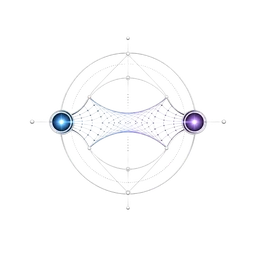
Phase 17 · gauge versus relational
Where The Path Breaks
AT-0135 → AT-0142. A legitimate symmetry can explain why two descriptions are the same state. It cannot by itself deliver relocation. The target remains a change in gauge-invariant relational location while identity is preserved.
The split this phase is built on
A legitimate symmetry can explain why two descriptions are the same state. It cannot by itself deliver relocation. Any relocation claim must change gauge-invariant / operational relational observables, not coordinates. Coordinate-only motion is REPRESENTATION CHANGE ONLY.
RERUNNABLE TOY BENCHMARK, NOT PHYSICS. Seed 135, 2D unit-circle model. (1) Under explicit rotational redundancy with the physical observable r = √(u² + v²), microscopic coordinate displacement approaches 2.0 while observable drift stays at the floating-point floor (~1e-16), because rotation is declared to be the equivalence symmetry — LEGITIMATE BY SPECIFIED SYMMETRY (within toy model). (2) In an omission control where only u is measured and v is ignored, states with near-equal u hide v differences of order 0.6 — INCOMPLETE OBSERVATION. These are controls, not results about nature.
Phase 24 carries this rule forward: DOES THE SYSTEM HEAL ITSELF? (AT-0191 → AT-0198) asks whether nonlinear self-repair can protect identity while genuine, gauge-invariant relational progress happens — and charges the memory bill it leaves behind.
Model controls
Changing the map is not the same as moving the territory. If everything rotates together, every coordinate on the page changes and nothing about the arrangement changes. Relocation has to show up in what the parts measure about each other, not in the labels we chose.
Where the path breaks
Intersecting the feasible sets…
The joint wall
Running the feasibility sweep…
Intersecting the feasible sets…