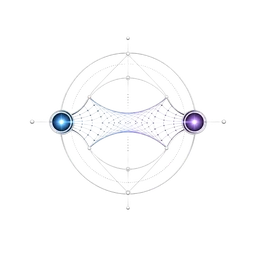
Phase 61 · compact addressing + sparse localized activation · AT-0557 → AT-0568
No map. No beacon. No global wake-up.
Seed 557. A generic BFS / landmark tree is built on a random connected cubic substrate before endpoints are selected; every node stores compact hierarchical ancestor data. The traveller carries B's compact address and reads only its immediate neighbours. Success is 1.000 at every size from N = 128 to N = 4096, route length runs 10 → 19 hops, per-node address size is exactly 4·log2 N bits, and only the traversed path plus a one-hop halo activates — about 42 nodes out of 4,096. Route, activation and address size all hold near-constant ratios against log2 N across five doublings. That is a window observation, not an asymptotic proof, and the local route still reads precomputed tree tables. Classification: compact-address infrastructure toy.
Plain language
Loading.
Headline readings
Routing success
…
N = 128 … 4,096, all six sizes
Activated per trip
…
routed path plus one-hop halo
Address bits / node
…
28 → 48 bits, floor is log2 N
Physical evidence
NONE
Verdict
…
Blockers raised
Next attack
Results · AT-0557 → AT-0568