The hypothesis
Effective separation as a derived quantity
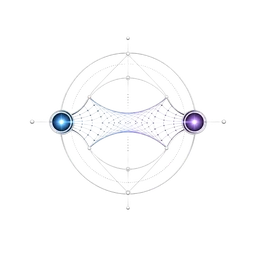
The Relational Distance Hypothesis (RDH) proposes that the separation between two systems is not a primitive of the description, but a function of the relational structure that binds them. Under RDH, asking “how far apart are A and B?” is a question about relations, and geometry is the answer that those relations happen to produce.
What the hypothesis does not say
- It does not say that distance can be edited. It says that if distance is derived, then the question of editing it becomes well-posed rather than incoherent.
- It does not treat entanglement as a channel. Entanglement alone carries no signal, and no result on this site contradicts that.
- It does not claim that any graph on this site is spacetime. The graph is a sandbox for validating our own software and reasoning.
The toy transform
AT-0 represents the relational system as a weighted graph G = (V, E) with couplings 0 < R_ij ≤ 1, mapped to an effective edge distance and closed under shortest weighted path.
Later stages replace arbitrary R with quantities motivated by information theory — for example the mutual information I(A:B) = S_A + S_B − S_AB — while explicitly testing whether the resulting construction has the properties a metric requires.