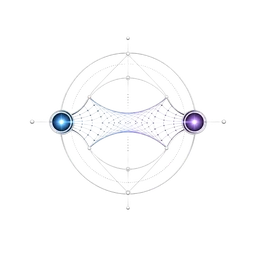
Portal-0
250 / 250
Clean synthetic missions; 200,000 fault trials
synthetic validation
Interactive research instrument · Portal-0 → Portal-1.5
Change the growth law, select a destination, inject faults and watch the evidence gate respond. Every number on this page is calculated or simulated in your browser. No result is presented as physical transport.
Instrument controls
Run #1 · 10,000 trials · deterministic pseudo-random test data. This control does not contact hardware.
Growth algebra engine
Possibilities
2^48
2.81e+14
Ordinary radius
65,536
rₒ ≈ N^(1/3)
Relational radius
29.71
rₕ ≈ ln(N)/λ
Model compression
2,206.13×
rₒ / rₕ
Ordinary ruler
rₒ(N) = N^(1/3)
The ruler traverses every coordinate interval in the visible cubic accessibility model.
Relational record-player pin
rₕ(N) = ln(N)/λ
The model selects an address through accessible transformations. No destination table or physical portal is implied.
Portal-1 hostile controller campaign
Trials
10,000
Injected faults
70
Blocked renders
70
Wrong renders
0
Modeled escape probability: 2^-16
Observed zero is not proof of zero risk. The modeled theoretical escape bound remains approximately 9.16e-8 per trial, before correlated or unmodeled failure.
Validated project checkpoints
Portal-0
250 / 250
Clean synthetic missions; 200,000 fault trials
synthetic validation
Portal-1.1
8,000
Adversarial missions; hash-tail truncation wall found and closed
synthetic validation
Portal-1.2
80,000
Evidence-gate trials; zero modeled conventional false candidates
synthetic validation
Portal-1.3
55,000
Asynchronous endpoint digital-twin trials
synthetic validation
Portal-1.5
3.2M
Randomized clock cycles plus 4,096 exhaustive transitions
synthetic validation
Evidence gate
Timing flag
Arrival clears ten times total uncertainty and the frozen guard band.
Apparatus anomaly
Payload, clocks, channels, transcript and independent replay remain clean.
Unmodeled physical channel
Independent hardware and an independent laboratory replicate the result.
Payload transport candidate
Source loss, destination gain, no duplicate, conservation closure and internal-state preservation all pass.
Current wall