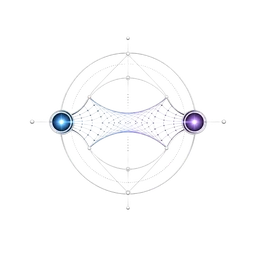
One covariant Einstein–Maxwell–scalar-style framework replaces the pile of separate toy mechanisms. Inside it, a scalar field sits at zero until an electromagnetic invariant crosses a finite threshold, switches on a bounded non-zero value, and relaxes back to zero the moment the trigger is removed. The mathematics of that switch survives our first consistency tests. It has never been near an apparatus, the dimensionful parameter window is not established, and the framework predicts no threshold at any particular field strength today.
TOY / THEORETICAL MODEL · NOT PHYSICAL VALIDATION · PHYSICAL EVIDENCE: NONE
Evidence status · permanent
Mathematical consistency of toy mechanism
FIRST PASS (INTERNAL SCAN)
Threshold + restoration behaviour
OBSERVED IN TOY MODEL
Dimensionful parameter window
NOT ESTABLISHED
General theory validated
NO
Physical experiment performed
NO
Peer review
NOT PERFORMED
Physical evidence
NONE
Exotic gravity / FTL / spacetime shortcut claimed
NONE
How to read this page
PROVEN
Established, independently verified physics. On this page: only the covariant framework type and the vacuum plane-wave invariant identity.
SIMULATED
Produced by our own numerical toy models. Real output, zero physical standing.
HYPOTHESIZED
Our own conjecture. No evidential weight at all.
NEXT TEST
The specific work that would move an item out of the class above it.
Current verdict
General theory
NOT VALIDATED
Unified toy mechanism
SURVIVES INITIAL MATHEMATICAL CONSISTENCY TESTS
Dimensionful parameter window
NOT ESTABLISHED
Physical experiment
NOT PERFORMED
Peer review
NOT PERFORMED
Physical evidence
NONE
1 · Unified model direction
PROVEN
S = ∫ d⁴x √(−g) [ M_Pl² R / 2 − ½ (∇φ)² − V(φ) − ¼ Z(φ) F_{μν} F^{μν} + L_m ]
Schematic. Gravity, one real scalar, one Maxwell field with a scalar-dependent coupling, plus matter.
The programme's earlier toy mechanisms were written one at a time, each with its own bespoke rules. This is the attempt to state all of them inside a single covariant action of an entirely conventional type: gravity, one real scalar, one Maxwell field with a scalar-dependent coupling, plus ordinary matter. Nothing in this action is new physics. Einstein–Maxwell–scalar models of exactly this shape are studied in the published literature. What is ours — and what is unproven — is the specific claim that a structure of this kind can be tuned so that an electromagnetic configuration acts as a switch for a bounded scalar region, and that such a region is what our earlier network toys were abstracting.
2 · Minimal toy phase-transition model
SIMULATED
Potential
V(φ) = ½ m² φ² + (λ/4) φ⁴
Gauge coupling
Z(φ) = 1 − a φ² + b φ⁴
Effective mass
m_eff² = m² − 2 a X
Critical threshold
X_c = m² / (2a)
Below threshold
φ* = 0 (state C0)
Above threshold
φ* = √[ (2aX − m²) / (λ + 4bX) ] (state C*)
C0
X < X_c
φ* = 0. The scalar is identically zero. Nothing is switched on.
C*
X > X_c
A bounded non-zero minimum grows continuously from zero.
C0
trigger removed
m_eff² returns positive and φ* → 0 automatically. Restoration is not imposed.
X is the magnetic-dominated electromagnetic invariant driving the coupling. Below X_c the effective mass squared is positive, the only minimum is at the origin and the scalar is identically zero. Above X_c the origin destabilises and a bounded new minimum appears, growing continuously from zero — a second-order-like transition with a finite critical threshold rather than a smooth amplification. Removing the trigger sends m_eff² positive again and φ* → 0 automatically; the restoration is not imposed by hand, it is what the potential does. That automatic return is the single property this programme most needed and could never previously derive.
3 · Internal parameter scan
SIMULATED
1,759
scanned states passing our limited toy consistency filters
Positive effective quartic — the bounded minimum exists and is not an artefact of a runaway direction.
Z(φ*) > 0 — the Maxwell kinetic term keeps the right sign at the new minimum, so the toy model is not obviously ghost-like there.
Finite critical threshold X_c — a real switch, not an asymptotic approach.
Bounded toy potential over the scanned field range.
Restoration — φ* returns to 0 when the trigger is withdrawn.
1,759 scanned parameter states passed these filters. This is an internal numerical scan of our own toy Lagrangian against our own limited consistency conditions. It is not an experimental confirmation, not a proof of stability, and not a survey against real-world constraints. The filters are necessary conditions we could check quickly, not a complete set of physical viability requirements.
4 · Representative normalized example
SIMULATED
m = 0.1 · λ = 1 · a = 5 · b = 0.01 · X_c = 0.001 (normalized units)
Drive X
φ*
Z(φ*)
1.25 X_c
≈ 0.050
≈ 1.00
2 X_c
≈ 0.100
≈ 0.95
3 X_c
≈ 0.141
≈ 0.90
Representative normalized example, not a prediction. φ* grows continuously above threshold and Z(φ*) stays positive across the scanned range, sitting near 0.90 at three times threshold. Units are arbitrary throughout; nothing here maps to a laboratory field strength.
5 · Dimensionful reality check
PROVENHYPOTHESIZED
u_B = B² / (2 μ₀)
Magnetic energy density. Ordinary electromagnetism, quoted for scale only.
1 T
≈ 3.98 × 10⁵ J/m³
10 T
≈ 3.98 × 10⁷ J/m³
45 T
≈ 8.06 × 10⁸ J/m³
100 T
≈ 3.98 × 10⁹ J/m³
If the dimensionless driver is X = u_EM / U₀ with X_c = 0.001, then reaching threshold at 45 T would require U₀ ≈ 8.06 × 10¹¹ J/m³. Read this the right way round: U₀ is a free, currently unknown normalization scale of the toy model. Choosing a threshold field fixes U₀; it does not derive it. This arithmetic therefore does NOT predict a 45 T threshold, or a threshold at any other field. Until U₀ is derived from a coupling scale rather than reverse-engineered from a wish, the model has no laboratory prediction at all.
6 · Invariant correction
PROVEN
A freely propagating vacuum plane wave has F_{μν}F^{μν} = 0.
Because E² = c²B² for a plane wave in vacuum, the invariant that drives this model vanishes identically for it. Raw laser intensity is therefore NOT automatically a trigger for an F²-coupled scalar, no matter how large. This correction removes the most obvious and most attractive experimental route, and it must stay visible. Configurations that could carry a non-zero invariant have to be studied instead: standing waves and cavities, quasi-static magnetic or electric configurations, crossed-field geometries, plasma configurations — or a different invariant altogether, at which point the coupling term changes and the whole scan must be redone.
7 · Gravity results carried forward
SIMULATED
G1
Weak self-gravity backreaction
In the controlled toy regime, including weak self-gravity changed C* propagation by only about −0.44% at the maximum weak-field proxy of ~3.4 × 10⁻³.
Reading: Ordinary weak gravity participates in the dynamics but appears to be a follower, not the engine. Whatever drives the transition, it is not weak-field gravitational backreaction.
G2
Scalar–tensor smooth amplification
A simple F(φ)R amplification became increasingly costly as the effective gravitational enhancement was strengthened; the cost grew faster than the benefit across the tested range.
Reading: Smooth amplification is the wrong shape. This is the result that motivated moving to threshold and screening behaviour — a switch that is off until it is on — rather than a dial that is turned harder.
8 · New parameter-window target
NEXT TEST
Derive the dimensional coupling scale rather than choose it.
Schematic coupling and the threshold structure it implies.
m_φ
Scalar mass — sets how fast the field restores and how far it reaches.
M
Dimensional coupling scale in the Maxwell sector — the quantity we must derive, not pick.
λ_φ = ħ / (m_φ c)
Coherence/range length. Macroscopic behaviour needs this to be laboratory-sized.
B_c / E_c
Implied laboratory threshold field, which follows from m_φ and M rather than being assumed.
Bounds
Existing fifth-force, precision-EM and astrophysical constraints on exactly this coupling.
The constraint triangle
T1 · Accessible threshold
F_c small enough to reach with real magnets, cavities or plasma configurations.
T2 · Macroscopic coherence
λ_φ = ħ/(m_φ c) large enough that the region is not sub-atomic.
T3 · Existing bounds
Fifth-force, precision-EM and astrophysical limits that a light, strongly coupled scalar must not already violate.
These three pull against each other. A light scalar gives macroscopic coherence but is the most tightly constrained; a heavy scalar evades bounds but confines the region to uselessly small scales; a low threshold demands strong coupling, which is what the bounds squeeze hardest. The programme's next real question is whether the triangle has an interior at all. If it is empty, the laboratory hypothesis is dead and we will say so on this page.
Claim-by-claim evidence ledger
PROVEN
Einstein–Maxwell–scalar actions of this type are a studied, conventional framework
PROVEN
A freely propagating vacuum plane wave has F_{μν}F^{μν} = 0
PROVEN
u_B = B²/(2μ₀) energy densities at 1–100 T
SIMULATED
Finite threshold X_c = m²/(2a) with automatic restoration in the toy potential
SIMULATED
1,759 parameter states passing our five internal consistency filters
SIMULATED
Weak self-gravity changes C* propagation by ~−0.44% in the controlled toy regime
SIMULATED
Smooth F(φ)R amplification is increasingly costly, motivating threshold/screening
HYPOTHESIZED
That this mechanism describes anything physical
HYPOTHESIZED
That a laboratory-accessible threshold field exists
HYPOTHESIZED
That the constraint triangle has a non-empty interior
NEXT TEST
Dimensionful (m_φ, M, λ) scan against fifth-force, EM and astrophysical bounds
NEXT TEST
Nucleation dynamics and interface-energy cost of a C* region
Next attack
NEXT TEST
N1
Scan (m_φ, M, self-coupling λ) against reality
Replace the normalized scan with a dimensionful one: sweep scalar mass, coupling scale and self-coupling, compute the implied threshold field and coherence length for each point, and test every point against lab-accessible field ranges and published fifth-force, precision-EM and astrophysical constraints. The output is either a surviving window or an empty set. Both are publishable and both get published here.
N2
Dynamics, nucleation and interface energy
Equilibrium minima are not a mechanism. If a window survives, the next gate is time-dependent: how a C* region nucleates, what the domain-wall/interface energy costs, whether the boundary is stable against the obvious instabilities, and how fast the field restores when the trigger is withdrawn. A static solution that cannot be switched on in finite time and finite energy is not a candidate.
N3
Hardware design — only after the gates above
No apparatus is designed until a dimensionful window survives the constraints and the dynamics gate. The programme has already learned the cost of designing hardware for a mechanism that had not cleared its own mathematics.
2026 literature alignment
Scalarization treated explicitly as a phase transition. July 2026 work in Physical Review D derives phase-transition behaviour for scalarized solutions from an energy functional rather than from linear instability alone.
Relevance: Supports that threshold-type scalar behaviour is a legitimate object of study in a conventional covariant framework. Says nothing about our laboratory hypothesis.
Einstein–Maxwell–scalar literature through 2026 continues to show that electromagnetic coupling can induce scalarization under specific strong-field conditions, typically around black holes and other compact objects.
Relevance: Establishes that an F²-coupled scalar switching on above a threshold is not an exotic invention. The conditions studied are astrophysical strong-field regimes, not benchtop fields.
These papers do NOT validate our hypothesis. They validate the shape of the mathematics we are using, in regimes we cannot reach. Citing them is a statement about where our model sits in the literature, not evidence for it. Any reading of this box as third-party support for a laboratory effect is a misreading.
In plain language
Everything in one rulebook
Before, we had lots of little separate ideas. Now we tried writing them all as one rulebook, the same kind grown-up physicists already use. In that rulebook there is a switch: nothing happens at all until you push hard enough, and then something switches on — and when you stop pushing, it switches itself off again. We found the switch works on paper. We do not know yet how hard you would have to push in the real world, and we have not pushed anything.